General description
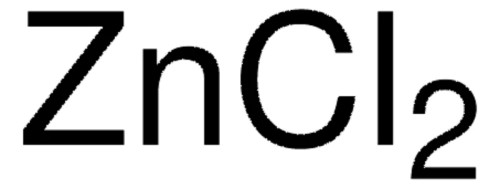
Electrodeposition of zinc on glassy carbon and nickel substrates in zinc chloride-1-ethyl-3-methylimidazolium chloride molten salt is studied.
Application
Zinc Chloride may be used:
- as catalyst in knoevenagel condensation of carbonyl substrates with acidic methylene reagents
- in the preparation of porous carbon nanofibers, useful in the fabrication of efficient electrodes for supercapacitors
- as a catalyst in preparation of poly(propylene fumarate)
- in the low temperature synthesis of nanocrystalline zinc oxide films
- in the synthesis of zinc oxide nanoparticles with low agglomeration. Aqueous suspensions of the nanoparticles displayed high transmittance in the visible light range, but exhibited strong absorption in the UV range.
Molecular Weight: 136.30. Empirical Formula: Cl
2Zn. linearFormula: ZnCl
2. grade: anhydrous. Quality Level: 200. vapor pressure: 1 mmHg ( 428 °C). Assay: ≥. 99.995% trace metals basis. form: powder. impurities: ≤. 50.0 . ppm Trace Metal Analysis . bp: 732 . °C/1 . atm (lit.). mp: 293 . °C (lit.). solubility: acetone: slightly soluble(lit.), ethanol: slightly soluble(lit.). SMILES string: [Cl-].[Cl-].[Zn++]. InChI: 1S/2ClH.Zn/h2*1H. /q. . +2/p-2. InChI key: JIAARYAFYJHUJI-UHFFFAOYSA-L. Pictograms: GHS05,GHS07,GHS09. Signal Word: Danger. Hazard Statements: H302 - H314 - H335 - H410. Precautionary Statements: P260 - P273 - P280 - P301 + P312 - P303 + P361 + P353 - P305 + P351 + P338. Hazard Classifications: Acute Tox. 4 Oral - Aquatic Acute 1 - Aquatic Chronic 1 - Eye Dam. 1 - Skin Corr. 1B - STOT SE 3. Target Organs: Respiratory system. Storage Class Code: 8B - Non-combustible, corrosive hazardous materials. WGK: WGK 3. Flash Point(F): Not applicable. Flash Point(C): Not applicable. Personal Protective Equipment: Eyeshields, Faceshields, Gloves, type P3 (EN 143) respirator cartridges.

 akash.verma@cenmed.com
 (732) 447-1115