 akash.verma@cenmed.com
 (732) 447-1115

General description
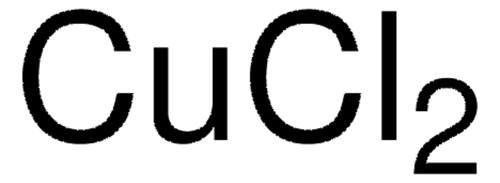
CuCl2 was used in studies investigating pleural fibrosis resulting from chronic inhalation of indium phosphide (InP) particles in mice.
Application
Catalyst for oxidation of alcohols under aerobic conditions.
Modified Markó′s aerobic oxidation of alcohols under atmospheric pressure with air or molecular oxygen at room temperature
Effective catalyst for the tetrahydropyranylation of alcohols, using mild conditions and in high yields.
Molecular Weight: 134.45. Empirical Formula: Cl2Cu. linearFormula: CuCl2. grade: anhydrous. Quality Level: 100. Assay: ≥. 99.995% trace metals basis. form: powder. impurities: ≤. 50.0 . ppm Trace Metal Analysis . mp: 620 . °C (lit.). density: 3.386 . g/mL . at 25 . °C (lit.). application(s): battery manufacturing. SMILES string: Cl[Cu]Cl. InChI: 1S/2ClH.Cu/h2*1H. /q. . +2/p-2. InChI key: ORTQZVOHEJQUHG-UHFFFAOYSA-L. Pictograms: GHS05,GHS07,GHS09. Signal Word: Danger. Hazard Statements: H302 + H312 - H315 - H318 - H410. Precautionary Statements: P264 - P273 - P280 - P301 + P312 - P302 + P352 + P312 - P305 + P351 + P338. Hazard Classifications: Acute Tox. 4 Dermal - Acute Tox. 4 Oral - Aquatic Acute 1 - Aquatic Chronic 2 - Eye Dam. 1 - Skin Irrit. 2. Storage Class Code: 8A - Combustible, corrosive hazardous materials. WGK: WGK 3. Flash Point(F): Not applicable. Flash Point(C): Not applicable. Personal Protective Equipment: dust mask type N95 (US), Eyeshields, Gloves.- UPC:
- 12141711
- Condition:
- New
- HazmatClass:
- Yes
- MPN:
- 451665-25G
- CAS:
- 7447-39-4