 akash.verma@cenmed.com
 (732) 447-1115

General description
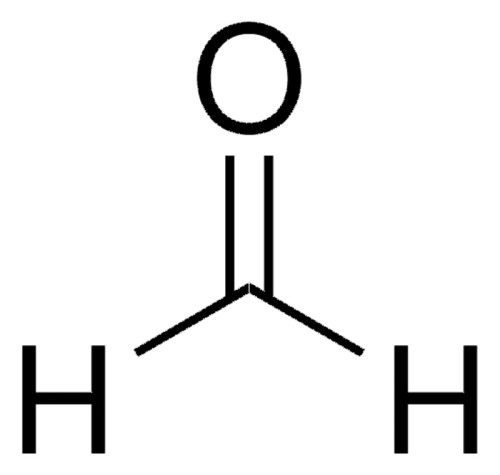
Formaldehyde is a molecular biology reagent that denaturates RNA during electrophoresis when incorporated in agarose gels.
It is an aliphatic aldehyde that is widely used in industrial applications for the synthesis of several chemicals such as melamine formaldehyde, urea-formaldehyde, phenol formaldehyde and industrial resins, paraformaldehyde, polyols, chelating agents, slow release fertilizers, 1,4-butanediol and hexamethylenetetramine.
Application
Formaldehyde solution is suitable for:
- denaturation and separation of RNA molecules
- anti-bacterial treatment
- fixation of cells
- in the fixation of human spermatogonial stem cell transplantation (SSCT).
- to crosslink T- cell acute lymphoblastic leukemia protein/DNA complex during chromatin immunoprecipitation.
- in fixing zebra fish larvae for neutrophil staining.
Caution
may contain precipitate (paraformaldehyde)
Principle
Formaldehyde disrupts the secondary structure of RNA and allows separation and identification of RNA species based on charge migration.
Molecular Weight: 30.03. Empirical Formula: CH2O. linearFormula: HCHO. grade: for molecular biology. Quality Level: 100. vapor density: 1.03 (vs air). vapor pressure: 52 mmHg ( 37 °C). product line: BioReagent. form: liquid. autoignition temp.: 572 . °F. contains: ~10% methanol as stabilizer. concentration: ≥. 36.0% in H2O (T), 36.0-38.0% (aldehyde method). technique(s): electrophoresis: suitable. impurities: ≤. 0.03% free acid (as HCOOH). ign. residue: ≤. 0.05% (as SO4). pH: 2.8-4.0. density: 1.09 . g/mL . at 20 . °C, 1.09 . g/mL . at 25 . °C (lit.). anion traces: chloride (Cl-): ≤. 10 . mg/kg, sulfate (SO42-): ≤. 20 . mg/kg. cation traces: Ca: ≤. 5 . mg/kg, Cd: ≤. 1 . mg/kg, Co: ≤. 1 . mg/kg, Cr: ≤. 1 . mg/kg, Cu: ≤. 1 . mg/kg, Fe: ≤. 1 . mg/kg, K: ≤. 20 . mg/kg, Mg: ≤. 1 . mg/kg, Mn: ≤. 1 . mg/kg, Na: ≤. 100 . mg/kg, Ni: ≤. 1 . mg/kg, Pb: ≤. 1 . mg/kg, Zn: ≤. 1 . mg/mL. λ: 2 . M in H2O. UV absorption: λ. : 260 . nm Amax: 0.01, λ. : 280 . nm Amax: 0.01. suitability: in accordance for electrophoresis of RNA in agarose gels. storage temp.: room temp. SMILES string: [H]C([H]): O. InChI: 1S/CH2O/c1-2/h1H2. InChI key: WSFSSNUMVMOOMR-UHFFFAOYSA-N. Pictograms: GHS02,GHS05,GHS06,GHS08. Signal Word: Danger. Hazard Statements: H226 - H301 + H311 - H314 - H317 - H330 - H335 - H341 - H350 - H370. Precautionary Statements: P202 - P210 - P280 - P303 + P361 + P353 - P304 + P340 + P310 - P305 + P351 + P338. Hazard Classifications: Acute Tox. 2 Inhalation - Acute Tox. 3 Dermal - Acute Tox. 3 Oral - Carc. 1B - Eye Dam. 1 - Flam. Liq. 3 - Muta. 2 - Skin Corr. 1B - Skin Sens. 1 - STOT SE 1 - STOT SE 3. Target Organs: Respiratory system. Storage Class Code: 3 - Flammable liquids. WGK: WGK 3. Flash Point(F): 133.0 °F - closed cup. Flash Point(C): 56.11 °C - closed cup. Personal Protective Equipment: Faceshields, Gloves, Goggles, type ABEK (EN14387) respirator filter.- UPC:
- 12352501
- Condition:
- New
- HazmatClass:
- Yes
- MPN:
- 47608-1L-F
- CAS:
- 50-00-0