Application
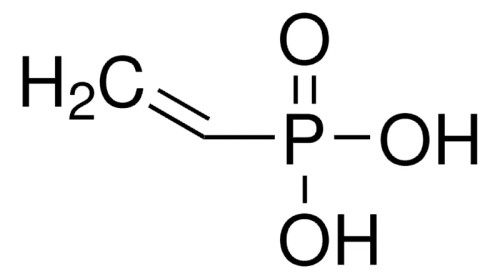
Vinylphosphonic acid (VPA) can be used as a monomer unit for the synthesis of poly(vinylphosphonic acid) via free radical polymerization. It is also used to develop copolymers of VPA with acrylonitrile, N-isopropylacrylamide, styrene, vinylpyrrolidone, and acrylic and methacrylic acid. These copolymers find potential application in hydrogels, drug delivery, biomimetic mineralization, and polymer electrolyte membranes in fuel cells.
It can also be used as an organic building block to prepare (E)-styryl phosphonic acid derivatives by reacting with various aryl halides via Pd-catalyzed Heck coupling reaction.
Molecular Weight: 108.03. Empirical Formula: C
2H
5O
3P. linearFormula: CH
2: CHP(O)(OH)
2. Quality Level: 100. Assay: ≥. 90.0% (T). impurities: ≤. 7.0% water. mp: 36 . °C (Lit. dry VPA) (lit.). density: 1.37 . g/mL . at 20 . °C (lit.). SMILES string: OP(O)(: O)C: C. InChI: 1S/C2H5O3P/c1-2-6(3,4)5/h2H,1H2,(H2,3,4,5). InChI key: ZTWTYVWXUKTLCP-UHFFFAOYSA-N. Pictograms: GHS05. Signal Word: Danger. Hazard Statements: H290 - H314. Precautionary Statements: P280 - P301 + P330 + P331 - P303 + P361 + P353 - P305 + P351 + P338. Hazard Classifications: Met. Corr. 1 - Skin Corr. 1B. Storage Class Code: 8A - Combustible, corrosive hazardous materials. WGK: WGK 1. Flash Point(F): 467.6 °F. Flash Point(C): 242 °C. Personal Protective Equipment: Faceshields, Gloves, Goggles, type ABEK (EN14387) respirator filter.

 akash.verma@cenmed.com
 (732) 447-1115