General description
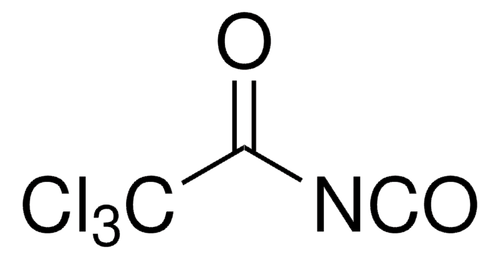
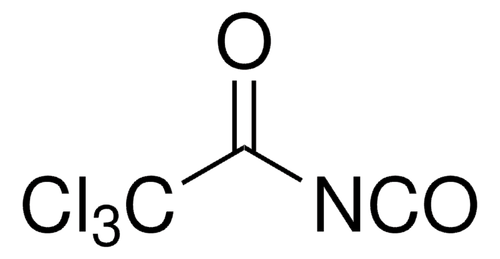
Conformational stability and vibrational IR and Raman spectra of trichloroacetyl isocyanate has been investigated. Trichloroacetyl isocyanate is commonly employed as in situ derivatizing reagent for the 13C NMR studies of alcohols, phenols and amines. It undergoes 1,5-cycloaddition reaction with anhydro-2-deoxy-D-erythro- and -L-threo-pent-1-enitols and 1,5-anhydro-2-deoxy-D- and -L-arabino-hex-1-enitols to yield [2+2] and [4+2] cycloadducts.
Application
Trichloroacetyl isocyanate was used in catalytic one-pot dehydrative glycosylation of 1-hydroxy carbohydrate. It was also used as a reagent for the conversion of alcohols to carbamates†.
Molecular Weight: 188.40. Empirical Formula: C
3Cl
3NO
2. linearFormula: Cl
3CCONCO. Quality Level: 200. Assay: 96%. refractive index:
n20/D 1.480 (lit.). bp: 80-85 . °C/20 . mmHg (lit.). density: 1.581 . g/mL . at 25 . °C (lit.). storage temp.: 2-8°C. SMILES string: ClC(Cl)(Cl)C(: O)N: C: O. InChI: 1S/C3Cl3NO2/c4-3(5,6)2(9)7-1-8. InChI key: GRNOZCCBOFGDCL-UHFFFAOYSA-N. Pictograms: GHS05,GHS06,GHS08. Signal Word: Danger. Hazard Statements: H311 + H331 - H314 - H317 - H334. Precautionary Statements: P261 - P271 - P280 - P303 + P361 + P353 - P304 + P340 + P310 - P305 + P351 + P338. Hazard Classifications: Acute Tox. 3 Dermal - Acute Tox. 3 Inhalation - Eye Dam. 1 - Resp. Sens. 1 - Skin Corr. 1B - Skin Sens. 1. Storage Class Code: 6.1A - Combustible, acute toxic Cat. 1 and 2 / very toxic hazardous materials. WGK: WGK 3. Flash Point(F): 150.8 °F - closed cup. Flash Point(C): 66 °C - closed cup. Personal Protective Equipment: Faceshields, Gloves, Goggles, type ABEK (EN14387) respirator filter.

 akash.verma@cenmed.com
 (732) 447-1115