 akash.verma@cenmed.com
 (732) 447-1115

General description
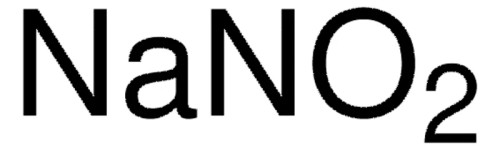
Sodium nitrite (NaNO2) is an inorganic compound that is commonly used as a reagent and catalyst in synthetic organic chemistry.
Application
Co-catalyst for catalytic oxidation of alcohols under aerobic, solvent-free conditions.
Solvent free aerobic oxidation of alcohols with 1-methyl-2-azaadamantane N-oxyl as a recyclable catalyst through phase separation
Sodium nitrite can be used as a reagent in:
- The Sandmeyer reaction for converting amines into diazo derivatives, and nitration reaction.
- The oxidative C-C bond formation reaction in the presence of oxygen as the terminal oxidant.
- The oxidative carbonitration of alkenes in the presence of K2S2O8.
It can also be used as a nitrating agent in organic synthesis. For example, NaNO2 is used in direct C-H nitration, ipso-nitration, and nitration via transition metal-catalyzed cross-coupling reaction.Molecular Weight: 69.00. Empirical Formula: NNaO2. linearFormula: NaNO2. grade: ACS reagent. Quality Level: 200. Assay: ≥. 97.0%. form: powder or crystals. autoignition temp.: 914 . °F. impurities: ≤. 0.01% insolubles. mp: 271 . °C (lit.). anion traces: chloride (Cl-): ≤. 0.005%, sulfate (SO42-): ≤. 0.01%. cation traces: Ca: ≤. 0.01%, Fe: ≤. 0.001%, K: ≤. 0.005%, heavy metals (as Pb): ≤. 0.001%. SMILES string: [Na+].[O-]N: O. InChI: 1S/HNO2.Na/c2-1-3. /h(H,2,3). /q. +1/p-1. InChI key: LPXPTNMVRIOKMN-UHFFFAOYSA-M. Pictograms: GHS03,GHS06,GHS09. Signal Word: Danger. Hazard Statements: H272 - H301 - H319 - H400. Precautionary Statements: P210 - P220 - P264 - P273 - P301 + P310 - P305 + P351 + P338. Hazard Classifications: Acute Tox. 3 Oral - Aquatic Acute 1 - Eye Irrit. 2 - Ox. Sol. 3. Storage Class Code: 5.1B - Oxidizing hazardous materials. WGK: WGK 3. Flash Point(F): Not applicable. Flash Point(C): Not applicable.
- UPC:
- 12141806
- Condition:
- New
- HazmatClass:
- Yes
- MPN:
- 237213-500G
- CAS:
- 7632-00-0