 akash.verma@cenmed.com
 (732) 447-1115

General description
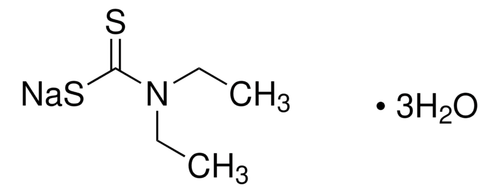
Sodium diethyldithiocarbamate trihydrate may be used:
- To synthesize cis-dichlorobis(N,N-diethyldithiocarbamato) tin(IV) by reacting with tin(II) chloride.
- As an alternative to xanthates to generate carbamoyl radical precursors.
- To synthesize a soluble precursor polymer for poly(thienylene vinylene).
- To synthesize dichlorotetrakis(dimethyl sulfoxide)ruthenium (II), which can be a precursor to prepare other ruthenium complexes.[17}
Application
Spin trap used in conjunction with Fe2+ to detect NO in brain, kidney, liver, and other tissues.
Spin trap used in conjunction with Fe2+ to detect NO in brain, kidney, liver, and other tissues. Simultaneous direct measurement of NO* and pO2 has been reported. A copper chelator, it has been used to quantitate copper in biological materials by ESR and is an inhibitor of superoxide dismutase, ascorbate oxidase, and other enzymes.
Biochem/physiol Actions
Inhibits induction of macrophage nitric oxide synthase.
Molecular Weight: 225.31. Empirical Formula: C5H10NNaS2 · 3H2O. linearFormula: (C2H5)2NCSSNa · 3H2O. grade: ACS reagent. Quality Level: 200. vapor density: 5.9 (vs air). composition: Na (as Na2SO4), 30.5-32.5% . mp: 95-98.5 . °C (lit.). SMILES string: [H]O[H].[H]O[H].[H]O[H].CCN(CC)C(: S)S[Na]. InChI: 1S/C5H11NS2.Na.3H2O/c1-3-6(4-2)5(7)8. . . . /h3-4H2,1-2H3,(H,7,8). . 3*1H2/q. +1. . . /p-1. InChI key: WWGXHTXOZKVJDN-UHFFFAOYSA-M. Pictograms: GHS05,GHS07. Signal Word: Danger. Hazard Statements: H302 - H315 - H318. Precautionary Statements: P264 - P270 - P280 - P301 + P312 - P302 + P352 - P305 + P351 + P338. Hazard Classifications: Acute Tox. 4 Oral - Eye Dam. 1 - Skin Irrit. 2. Storage Class Code: 11 - Combustible Solids. WGK: WGK 3. Flash Point(F): Not applicable. Flash Point(C): Not applicable. Personal Protective Equipment: dust mask type N95 (US), Eyeshields, Gloves.- UPC:
- 12352316
- Condition:
- New
- HazmatClass:
- No
- MPN:
- 228680-100G
- CAS:
- 20624-25-3