 akash.verma@cenmed.com
 (732) 447-1115

Application
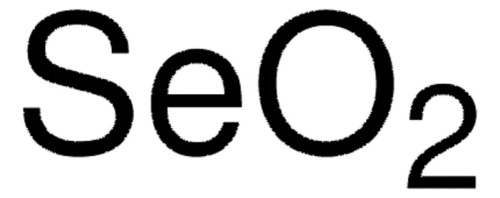
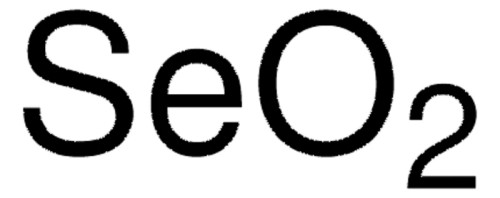
Selenium dioxide (SeO2) is mainly used to oxidize the α-methylene carbon atoms adjacent to a double bond to form allylic hydroxy derivatives.
Other applications:
- SeO2 reacts with olefins in the presence of tert-butyl hydrogen peroxide to form allylic alcohols without the formation of rearrangement or dehydration by-products. This reagent system is also useful for the oxidation reactions of acetylenic fatty esters.
- SeO2 can be used for the oxidation of 1,3,5-cycloheptatriene to form tropone.
- Piperidoindole systems on oxidation with SeO2 forms either 2-acyl- or 3-acyl-indoles or fully aromatic β-carbolines, depending on the starting material.
- SeO2 reacts with chlorotrimethylsilane to form selenium oxychloride in situ, which is an effective chlorinating reagent for alcohols. This reagent is a better alternative to thionyl chloride and other chlorinating agents.
Molecular Weight: 110.96. Empirical Formula: O2Se. linearFormula: SeO2. grade: reagent grade. Quality Level: 200. vapor pressure: 1 mmHg ( 157 °C). Assay: 98%. form: powder. reaction suitability: reagent type: oxidant. color: off-white to pink. mp: 315 . °C (subl.) (lit.). SMILES string: O: [Se]: O. InChI: 1S/O2Se/c1-3-2. InChI key: JPJALAQPGMAKDF-UHFFFAOYSA-N. Pictograms: GHS06,GHS08,GHS09. Signal Word: Danger. Hazard Statements: H301 + H331 - H373 - H410. Precautionary Statements: P260 - P264 - P273 - P301 + P310 - P304 + P340 + P311 - P314. Hazard Classifications: Acute Tox. 3 Inhalation - Acute Tox. 3 Oral - Aquatic Acute 1 - Aquatic Chronic 1 - STOT RE 2. Storage Class Code: 6.1C - Combustible, acute toxic Cat.3 / toxic compounds or compounds which causing chronic effects. WGK: WGK 2. Flash Point(F): Not applicable. Flash Point(C): Not applicable. Personal Protective Equipment: Eyeshields, Faceshields, Gloves, type P2 (EN 143) respirator cartridges.
- UPC:
- 12141910
- Condition:
- New
- HazmatClass:
- Yes
- MPN:
- 325473-500G
- CAS:
- 2025852
- Temperature Control Device:
- Yes