General description
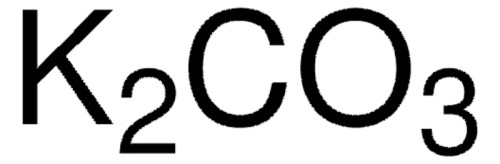
Potassium carbonate is an inorganic base. It participates as base in the palladacycle catalyzed Heck reaction of chlorobenzene with styrene.
Application
Potassium carbonate was used in the following studies:
- Synthesis of polysubstituted iodobenzene derivatives.
- As base for the synthesis of high molecular weight homopolymers and copolymers derived from various bisphenols.
- As base for the Suzuki coupling of aryl halides with aryl boronic acids.
- As base for the Heck reaction of styrene and bromobenzene.
Molecular Weight: 138.21. Empirical Formula: CK
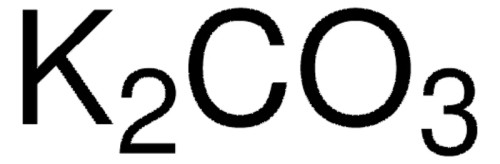
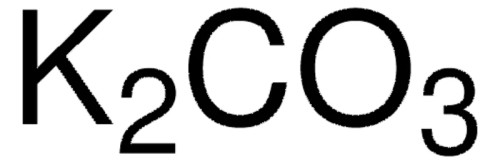
2O
3. linearFormula: K
2CO
3. grade: reagent grade. Quality Level: 200. Assay: ≥. 98%. form: powder. particle size: −. 325 . mesh. pH: 11-13 (25 . °C, 138 . g/L). mp: 891 . °C (lit.). SMILES string: [K+].[K+].[O-]C([O-]): O. InChI: 1S/CH2O3.2K/c2-1(3)4. . /h(H2,2,3,4). . /q. 2*+1/p-2. InChI key: BWHMMNNQKKPAPP-UHFFFAOYSA-L. Pictograms: GHS07. Signal Word: Warning. Hazard Statements: H315 - H319 - H335. Precautionary Statements: P261 - P264 - P271 - P280 - P302 + P352 - P305 + P351 + P338. Hazard Classifications: Eye Irrit. 2 - Skin Irrit. 2 - STOT SE 3. Target Organs: Respiratory system. Storage Class Code: 13 - Non Combustible Solids. WGK: WGK 1. Flash Point(F): Not applicable. Flash Point(C): Not applicable.

 akash.verma@cenmed.com
 (732) 447-1115