 akash.verma@cenmed.com
 (732) 447-1115

General description
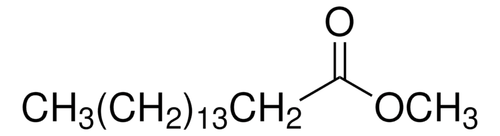
Palmitic acid belongs to the group of saturated fatty acids and accounts for 20-30 % of the total fatty acids present in the human body.
This substance is listed on the positive list of the EU regulation 10/2011 for plastics intended to come into contact with food. Find all available reference materials for compounds listed in 10/2011 here
Application
This analytical standard can also be used as follows:
- Development of a non-destructive Vis-NIR reflectance spectroscopy-based method for the detection of four fatty acids in 93 samples of seven different edibles oils
- Simultaneous identification and quantification of fatty acids from blood plasma samples after their methyl derivatization by large-volume injection (LVI) gas chromatography combined with vacuum ultraviolet spectroscopy (GC-VUV)
- Determination of the fatty acid composition of sunflower seed oils extracted from 93 different sunflower varieties by near-infrared reflectance spectroscopy (NIRS) combined with modified partial least squares (MPLS) and partial least squares (PLS) regression methods
- Separation and quantification of palmitic, oleic, linoleic, and linolenic acids from 186 samples of sea buckthorn seed oil using near-infrared spectroscopy (NIR) in combination with four different combinations of multivariate calibration methods— partial least squares (PLS), PLS-uninformative variables elimination (UVE), PLS- competitive adaptive reweighted sampling (CARS), and multiple linear regression (MLR)-UVE
- Quantitative analysis of various bioactive compounds from the ethanolic extract of sesame seeds by gas chromatography-mass spectrometry (GC-MS)
- Multi-residue analysis of oleic acid and other related fatty acids using a derivatization-free method based on gas chromatography-flame ionization detection (GC-FID)
- Ultra-performance liquid chromatography-mass spectrometry (UHPLC) method-based separation, identification, and determination of eight saturated and unsaturated fatty acids in eight different commercial samples of olive oil without any prior sample treatment
- Development of a liquid chromatography-mass spectrometry (LC-MS) method to measure seven fatty acid esters of hydroxy fatty acids (FAHFAs), four fatty acids, and four cardiovascular-related biomarkers in plasma samples of 57 healthy individuals
Other Notes
Refer to the product′s Certificate of Analysis for more information on a suitable instrument technique. Contact Technical Service for further support.
Molecular Weight: 256.42. Empirical Formula: C16H32O2. linearFormula: CH3(CH2)14COOH. grade: analytical standard. Quality Level: 100. vapor pressure: 10 mmHg ( 210 °C). Assay: ≥. 99.0% (GC). shelf life: limited shelf life, expiry date on the label. technique(s): HPLC: suitable, gas chromatography (GC): suitable. bp: 271.5 . °C/100 . mmHg (lit.). mp: 61-62.5 . °C (lit.). density: 0.852 . g/mL . at 25 . °C (lit.). application(s): cleaning productscosmetics
food and beverages
personal care. format: neat. functional group: carboxylic acid. shipped in: ambient. storage temp.: room temp. SMILES string: CCCCCCCCCCCCCCCC(O): O. InChI: 1S/C16H32O2/c1-2-3-4-5-6-7-8-9-10-11-12-13-14-15-16(17)18/h2-15H2,1H3,(H,17,18). InChI key: IPCSVZSSVZVIGE-UHFFFAOYSA-N. Storage Class Code: 11 - Combustible Solids. WGK: nwg. Flash Point(F): 235.4 °F. Flash Point(C): 113 °C. Personal Protective Equipment: dust mask type N95 (US), Eyeshields, Gloves.
- UPC:
- 12352321
- Condition:
- New
- HazmatClass:
- No
- MPN:
- 76119-5G
- CAS:
- 57-10-3