 akash.verma@cenmed.com
 (732) 447-1115


Application
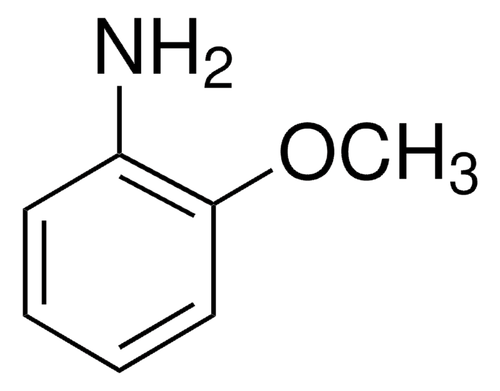
p-Anisidine can undergo aerobic oxidation in the presence of gold catalysts to form aromatic azo compounds.
p-Anisidine can be used:
- In the diastereoselective and enantioselective synthesis of CF3-substituted azoridines catalyzed by a chiral Bronsted acid.
- To prepare 4-organoselenium-quinolines through multi-component Povarov reaction with ethyl glyoxylate and ethynyl(phenyl)selane, catalyzed by Yb(OTf)3.
- As a starting material to synthesize 3-fluoro-6-methoxyquinoline in two steps.,
- To prepare N-PMP protected α-aminopropargylphosphonates by reacting with terminal alkynes and diethyl formylphosphonate hydrate using silver(I) triflate as a catalyst.
Molecular Weight: 123.15. Empirical Formula: C7H9NO. linearFormula: CH3OC6H4NH2. Quality Level: 200. Assay: 99%. form: solid. autoignition temp.: 959 . °F. bp: 240-243 . °C (lit.). mp: 56-59 . °C (lit.). SMILES string: COc1ccc(N)cc1. InChI: 1S/C7H9NO/c1-9-7-4-2-6(8)3-5-7/h2-5H,8H2,1H3. InChI key: BHAAPTBBJKJZER-UHFFFAOYSA-N. Pictograms: GHS06,GHS08,GHS09. Signal Word: Danger. Hazard Statements: H300 + H310 + H330 - H350 - H373 - H400. Precautionary Statements: P202 - P260 - P273 - P280 - P302 + P352 + P310 - P304 + P340 + P310. Hazard Classifications: Acute Tox. 1 Dermal - Acute Tox. 2 Inhalation - Acute Tox. 2 Oral - Aquatic Acute 1 - Carc. 1B - STOT RE 2. Storage Class Code: 6.1A - Combustible, acute toxic Cat. 1 and 2 / very toxic hazardous materials. WGK: WGK 3. Flash Point(F): 251.6 °F - closed cup. Flash Point(C): 122 °C - closed cup.
- UPC:
- 51101630
- Condition:
- New
- HazmatClass:
- Yes
- MPN:
- A88255-1KG
- CAS:
- 104-94-9