General description
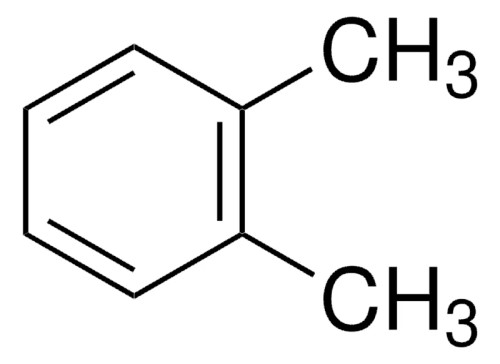
O-Xyleneis an aromatic hydrocarbon composed of two methyl substituents attached to adjacent carbon atoms. It has extremely low solubility in water. It is used to produce plasticizers, dyes, and pigments. Petroleum cracking produces O-Xylenes, which are used to generate phthalic anhydride, a precursor to many products, drugs, and chemicals.
Application
O-Xylene is used:
- As an additive of dope solutions in the preparation of PES (polyethersulfone) hollow fiber membranes.
- To produce phthalic anhydride.
Analysis Note
Assay (GC, area%): ≥ 98.0 % (a/a)
Density (d 20 °C/ 4 °C): 0.878 - 0.881
Identity (IR): passes test
Molecular Weight: 106.17. Empirical Formula: C
8H
10. linearFormula: C
6H
4(CH
3)
2. vapor density: 3.7 (vs air). Quality Level: 200. vapor pressure: <. 0.1 atm ( 21.1 °C), 16 mmHg ( 37.7 °C), 7 mmHg ( 20 °C). Assay: ≥. 98% (GC). form: liquid. autoignition temp.: 867 . °F. expl. lim.: 7 . %. refractive index:
n20/D 1.505 (lit.). bp: 143-145 . °C (lit.). mp: -26--23 . °C (lit.). transition temp: flash point 30 . °C. density: 0.879 . g/mL . at 20 . °C (lit.). storage temp.: 2-30°C. SMILES string: Cc1ccccc1C. InChI: 1S/C8H10/c1-7-5-3-4-6-8(7)2/h3-6H,1-2H3. InChI key: CTQNGGLPUBDAKN-UHFFFAOYSA-N. Pictograms: GHS02,GHS07,GHS08. Signal Word: Danger. Hazard Statements: H226 - H304 - H312 + H332 - H315 - H319 - H335 - H412. Precautionary Statements: P210 - P273 - P280 - P301 + P310 - P303 + P361 + P353 - P331. Hazard Classifications: Acute Tox. 4 Dermal - Acute Tox. 4 Inhalation - Aquatic Chronic 3 - Asp. Tox. 1 - Eye Irrit. 2 - Flam. Liq. 3 - Skin Irrit. 2 - STOT SE 3. Target Organs: Respiratory system. Storage Class Code: 3 - Flammable liquids. WGK: WGK 2. Flash Point(F): 89.6 °F - closed cup. Flash Point(C): 32.0 °C - closed cup.

 akash.verma@cenmed.com
 (732) 447-1115