Application
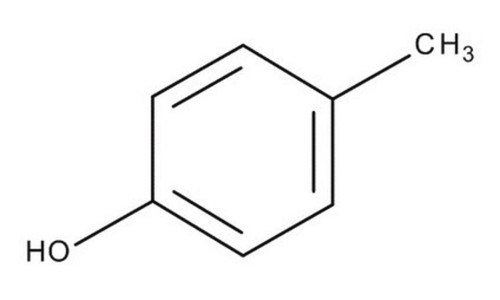
o-Cresol can be used as a starting material to synthesize:
- Carvacrol by alkylation reaction with propylene or isopropyl alcohol in the presence of Zr/mesoporous silica as a catalyst.
- Polyisobutylenes by selective cationic polymerization of isobutylene using AlCl3 as a catalyst.
- Poly(o-cresol) via oxidative coupling polymerization reaction in the presence of substituted pyridine/CuCl catalysts.
Analysis Note
Assay (GC, area%): ≥ 99.0 % (a/a)
Melting range (lower value): ≥ 29 °C
Melting range (upper value): ≤ 33 °C
Water (K. F.): ≤ 0.10 %
Identity (IR): passes test
Due to its specific melting range the product may be solid, liquid, a solidified melt or a supercooled melt.
Molecular Weight: 108.14. Empirical Formula: C
7H
8O. linearFormula: 2-(CH
3)C
6H
4OH. vapor pressure: 0.24 hPa ( 20 °C). Quality Level: 200. Assay: ≥. 99% (GC). form: solid. autoignition temp.: 555 . °C. potency: 121 . mg/kg LD
50, oral (Rat), 890 . mg/kg LD
50, skin (Rabbit). expl. lim.: 1.3 . % (v/v). pH: 4.8 (20 . °C, 20 . g/L in H
2O). bp: 191-192 . °C/1013 . hPa. mp: 31 . °C. transition temp: flash point 81 . °C. solubility: 20 . g/L. density: 1.046 . g/cm
3 . at 20 . °C. storage temp.: no temp limit. InChI: 1S/C7H8O/c1-6-4-2-3-5-7(6)8/h2-5,8H,1H3. InChI key: QWVGKYWNOKOFNN-UHFFFAOYSA-N. Pictograms: GHS05,GHS06. Signal Word: Danger. Hazard Statements: H301 + H311 - H314 - H412. Precautionary Statements: P260 - P273 - P280 - P303 + P361 + P353 - P304 + P340 + P310 - P305 + P351 + P338. Hazard Classifications: Acute Tox. 3 Dermal - Acute Tox. 3 Oral - Aquatic Chronic 3 - Eye Dam. 1 - Skin Corr. 1B. Storage Class Code: 6.1A - Combustible, acute toxic Cat. 1 and 2 / very toxic hazardous materials. WGK: WGK 2. Flash Point(F): 177.8 °F - closed cup. Flash Point(C): 81.0 °C - closed cup.

 akash.verma@cenmed.com
 (732) 447-1115