 akash.verma@cenmed.com
 (732) 447-1115

General description
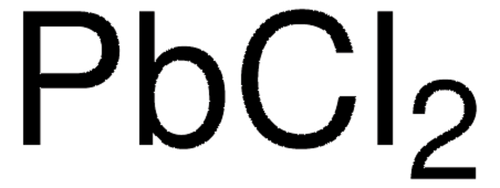
Prepared by reacting lead(II) oxide /acetate or carbonate with HCl. In crystalline PbCl2, each atom is coordinated by nine Cl atoms, six of which lie at the apices of a trigonal prism and the remaining three beyond the centers of the three prism faces. Each Cl is coordinated by four or five Pb atoms. Upon exposure to air it form basic chlorides such as PbCl2.Pb(OH)2.
Application
Lead(II) chloride (PbCl2) (99.999%) is a lead halide that can be used in the formation of a precursor solution to form perovskite films. These films and sheets can be used in the fabrication of hybride solar absorbers and photodetectors. It also has potential application as a thermoelectric material.
Molecular Weight: 278.11. Empirical Formula: Cl2Pb. linearFormula: PbCl2. vapor pressure: 1 mmHg ( 547 °C). Quality Level: 200. Assay: 99.999% trace metals basis. form: powder and chunks. reaction suitability: reagent type: catalystcore: lead. impurities: ≤. 15.0 . ppm Trace Metal Analysis. bp: 950 . °C (lit.). mp: 501 . °C (lit.). solubility: aliphatic hydrocarbons: slightly soluble(lit.). density: 5.85 . g/mL . at 25 . °C (lit.). SMILES string: Cl[PbH2]Cl. InChI: 1S/2ClH.Pb/h2*1H. /q. . +2/p-2. InChI key: HWSZZLVAJGOAAY-UHFFFAOYSA-L. Pictograms: GHS07,GHS08,GHS09. Signal Word: Danger. Hazard Statements: H302 + H332 - H351 - H360Df - H372 - H410. Precautionary Statements: P202 - P260 - P273 - P301 + P312 - P304 + P340 + P312 - P308 + P313. Hazard Classifications: Acute Tox. 4 Inhalation - Acute Tox. 4 Oral - Aquatic Acute 1 - Aquatic Chronic 1 - Carc. 2 - Repr. 1A - STOT RE 1. Storage Class Code: 6.1C - Combustible, acute toxic Cat.3 / toxic compounds or compounds which causing chronic effects. WGK: WGK 3. Flash Point(F): Not applicable. Flash Point(C): Not applicable. Personal Protective Equipment: Eyeshields, Gloves, type P3 (EN 143) respirator cartridges.
- UPC:
- 12141723
- Condition:
- New
- HazmatClass:
- Yes
- MPN:
- 203572-50G
- CAS:
- 7758-95-4