General description
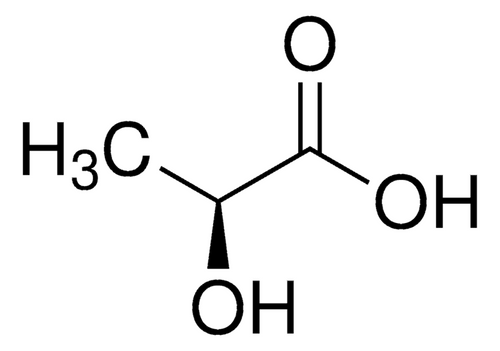
L-(+)-Lactic acid is the only naturally occurring lactic acid in humans and mammals. Commercially, few bacteria like Lactobacillus casei, L. delbrueckii, Streptococcus lactis produces L-Lactic acid by fermentation process. Lactic acid activates hydroxycarboxylic acid receptor, G-protein coupled receptor 81 (GPR81).
Application
Lactic acid has been used:
- as a component in substrate solution II for lactate dehydrogenase reaction
- as an additive in storage solution A
- as a supplement in the artificial gastric juice preparation for evaluation of degree of resistance Lactobacillus to the gastric stresses
Biochem/physiol Actions
L-(+)-Lactic acid is used as a substrate for lactic acid dehydrogenase and lactate oxidase.
Molecular Weight: 90.08. Empirical Formula: C
3H
6O
3. Quality Level: 200. Assay: ≥. 98%. antibiotic activity spectrum: Gram-negative bacteria. Mode of action: cell membrane | interferes. storage temp.: 2-8°C. SMILES string: C[C@H](O)C(O): O. InChI: 1S/C3H6O3/c1-2(4)3(5)6/h2,4H,1H3,(H,5,6)/t2-/m0/s1. InChI key: JVTAAEKCZFNVCJ-REOHCLBHSA-N. Pictograms: GHS05. Signal Word: Danger. Hazard Statements: H314. Precautionary Statements: P260 - P280 - P303 + P361 + P353 - P304 + P340 + P310 - P305 + P351 + P338 - P363. Hazard Classifications: Eye Dam. 1 - Skin Corr. 1C. Supp Hazards: EUH071. Storage Class Code: 8A - Combustible, corrosive hazardous materials. WGK: WGK 1. Flash Point(F): 230.0 °F - closed cup. Flash Point(C): 110.00 °C - closed cup. Personal Protective Equipment: dust mask type N95 (US), Eyeshields, Gloves.

 akash.verma@cenmed.com
 (732) 447-1115