 akash.verma@cenmed.com
 (732) 447-1115

Halloysite nanoclay has a tube like morphology. It shows low electrical, thermal conductivity and strong hydrogen interactions, on account of which the inner hydroxyl groups show greater stability than the surface hydroxyl groups in halloysite. The loss of hole water occurs at nearly 300 °C. Similar to montmorillonite, halloysite consists of two layers of aluminosilicate in 1:1 Al:Si ratio. Significant improvements in thermal, mechanical properties have been reported on addition of halloysite nanotubes in polymer composites.ApplicationHalloysite is frequently used as a reinforcement in various nanocomposites, some of which are listed here: Isotactic propylene-halloysite nanocomposites. Alloy composites by electroless/ autocatalytic deposition. Poly(butylene terephthalate) (PBT) composites. Zinc–halloysite nanotube (HNT) composite coatings. Halloysite nanotube–hydroxyapatite–hyaluronic acid films. Halloysite combined with polyamide, polypropylene, poly(ε-caprolactone) and fluroelastomers. Its tube like morphology, high aspect ratio, and low percolation enables interesting applications as reinforcements in nanocomposites.
Molecular Weight: 294.19
PubChem CID: 56841936
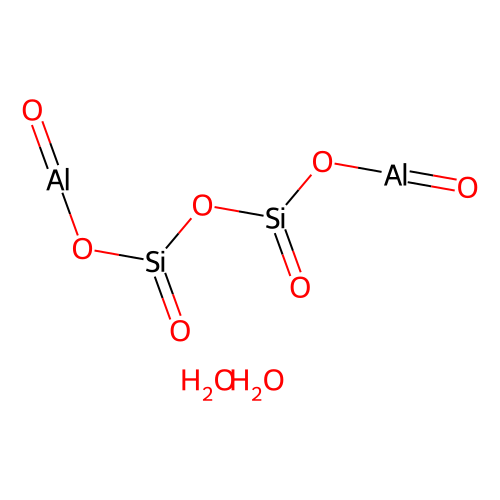
Isomeric SMILES: O.O.O=[Al]O[Si](=O)O[Si](=O)O[Al]=O
Related Documents: https://ald-pub-files.oss-cn-shanghai.aliyuncs.com/aladdinsci/pdp/sds/1/H431905-SCI_ae2ff9c7146ea8e33fdf806d7e2b6c25.pdf
- UPC:
- 12141607
- Condition:
- New
- HazmatClass:
- No
- WeightUOM:
- LB
- MPN:
- H431905-25g
- CAS:
- 1332-58-7
- Product Size:
- 25g