 akash.verma@cenmed.com
 (732) 447-1115

General description
The Csf3r (colony stimulating factor 3 receptor (granulocyte)) gene encodes a prototypical mobilizing cytokine.
Application
Granulocyte Colony-Stimulating Factor from mouse has been used in cytokine therapy.
Biochem/physiol Actions
G-CSF is a proliferation, differentiation, survival, and activation factor for hematopoietic cells of the restricted neutrophilic granulocyte lineage. It is produced by macrophages activated by endotoxin (LPS), by monocytes activated by TNF-α with IFNγ, by fibroblasts and endothelial cells activated by IL-1 or TNF-α, and by bone marrow stromal cells activated by IL-1 or LPS. It is suggested that during the inflammatory process endotoxins stimulate tissue macrophages to produce not only G-CSF but several other cytokines, including IL-1 and TNF-α, which in turn stimulate more G-CSF release from endothelial cells and fibroblasts. G-CSF can also synergize with IL-3 to shorten the G0 period of early hematopoietic progenitors. In addition to the namesake proliferative activity, G-CSF acts on mature neutrophils to enhance their survival and to stimulate their tumorcidal activity. Human G-CSF binds and activates a 130 kD to150 kD glycoprotein single chain receptor that has been classified as a member of the hematopoietic (cytokine) receptor family, the cytokine receptor class I, or the gp130 related cytokine receptor family (although it does not apparently bind to gp130). G-CSF receptors can be found on neutrophils, myeloid leukemia cells that respond to G-CSF, bone marrow cells of neutrophilic granulocyte lineage, and on placental trophoblasts, plus a soluble form may be expressed. Two forms of human G-CSF (177 and 174 amino acids) are synthesized from a single gene by alternative splicing, but murine G-CSF is a single expressed form of 178 amino acids. Human and murine G-CSF share 73% amino acid sequence homology and full cross-reactivity.
Granulocyte colony-stimulating factor (G-CSF) is a lineage-restricted hematopoietic growth factor, stimulating final mitotic divisions and the terminal cellular maturation of the partially differentiated hematopoietic progenitors. G-CSF3,4 is produced by monocytes and fibroblasts. It stimulates granulocyte colony formation, activates neutrophils and mature granulocytes, and promotes differentiation of certain myeloid leukemic cells. Natural G-CSF is a glycoprotein of 177 amino acids and a molecular weight of 19 kDa.5 Human and murine G-CSF have about 75% homology and show biological cross-reactivity.
Physical form
Lyophilized from a 0.2 μm filtered solution in 10 mM citric acid, 0.01% TWEEN® 20, pH 4.0, containing 50 μg bovine serum albumin per 1 μg of cytokine.
Analysis Note
The biological activity is measured in a cell proliferation assay using a murine myeloblastic cell line, NFS-60.
Legal Information
TWEEN is a registered trademark of Croda International PLC
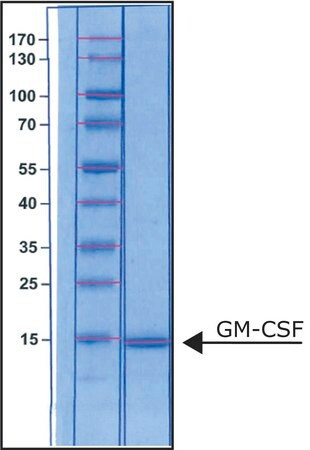
biological source: mouse. Quality Level: 100. recombinant: expressed in E. coli. Assay: >. 97% (SDS-PAGE). form: lyophilized powder. potency: 10-60 . pg/mL ED50. quality: endotoxin tested. mol wt: 19 . kDa (179 amino acids including N-terminal methionine). packaging: pkg of 5 and 25 . μ. g. storage condition: avoid repeated freeze/thaw cycles. technique(s): cell culture | mammalian: suitable. impurities: ≤. 0.01 . EU/μ. g. UniProt accession no.: P09920. storage temp.: −. 20°C. Gene Information: mouse ... Csf3(12985), Csf3r(12986). Pictograms: GHS07. Signal Word: Warning. Hazard Statements: H319 - H335. Precautionary Statements: P261 - P264 - P271 - P280 - P304 + P340 + P312 - P305 + P351 + P338. Hazard Classifications: Eye Irrit. 2 - STOT SE 3. Target Organs: Respiratory system. Storage Class Code: 11 - Combustible Solids. WGK: WGK 3. Flash Point(F): Not applicable. Flash Point(C): Not applicable. Personal Protective Equipment: Eyeshields, Gloves, type N95 (US).- UPC:
- 51131802
- Condition:
- New
- HazmatClass:
- No
- MPN:
- G8160-5UG