Application
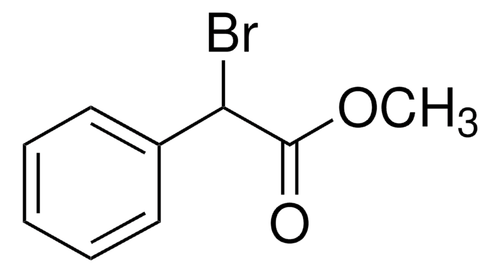
Ethyl α-bromophenylacetate (EBPA) may be used to synthesize α-ethoxycarbonyl-N,α-diphenylnitrone.
EBPA may be used as an initiator for the following:
- polymerization of dimethyl(methacryloyloxymethyl) phosphonate
- polymerization of methyl methacrylate (MMA)
- polymerization of trimethylolpropane triacrylate(TMPTA)
Molecular Weight: 243.10. Empirical Formula: C
10H
11BrO
2. linearFormula: C
6H
5CHBrCOOCH
2CH
3. Quality Level: 100. Assay: 97%. refractive index:
n20/D >. 1.5390 (lit.). bp: 89-92 . °C/0.9 . mmHg (lit.). density: 1.389 . g/mL . at 25 . °C (lit.). SMILES string: CCOC(: O)C(Br)c1ccccc1. InChI: 1S/C10H11BrO2/c1-2-13-10(12)9(11)8-6-4-3-5-7-8/h3-7,9H,2H2,1H3. InChI key: BKTKLDMYHTUESO-UHFFFAOYSA-N. Pictograms: GHS05. Signal Word: Danger. Hazard Statements: H314. Precautionary Statements: P280 - P303 + P361 + P353 - P304 + P340 + P310 - P305 + P351 + P338 - P363 - P405. Hazard Classifications: Eye Dam. 1 - Skin Corr. 1B. Storage Class Code: 8A - Combustible, corrosive hazardous materials. WGK: WGK 3. Flash Point(F): 230.0 °F - closed cup. Flash Point(C): 110 °C - closed cup. Personal Protective Equipment: Faceshields, Gloves, Goggles, type ABEK (EN14387) respirator filter.
- UPC:
- 12352101
- Condition:
- New
- HazmatClass:
- Yes
- MPN:
- 554065-100G
- CAS:
- 2882-19-1
- Temperature Control Device:
- Yes

 akash.verma@cenmed.com
 (732) 447-1115