General description
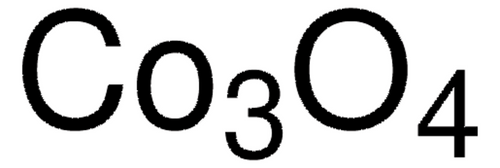
Cobalt oxide is a p-type semiconductor thatbelongs to the normal spinel crystal structure with cubic close packing ofoxide ions. It has variable oxidation states and multiple band gapenergies (2.28eV and 1.57eV). It is paramagnetic at room temperature.
Application
Cobalt(II,III) oxide nanoparticles can be used:
- To modify the glassycarbon electrode for the detection of As(III) at nanomolar concentrationrange.
- To prepare a robust photocatalyst along withcarbon nanospheres for dye degradation and hydrogen evolution reaction.
- As an electrodematerial in the preparation of supercapacitors.
Molecular Weight: 240.80. Empirical Formula: Co
3O
4. linearFormula: ~Co
3O
4. Quality Level: 200. Assay: 99.5% trace metals basis. form: nanopowder. surface area: 40-70 . m
2/g , typical range. particle size: <. 50 . nm (TEM). mp: 895 . °C (dec.) (lit.). density: 6.11 . g/mL . at 25 . °C (lit.). bulk density: 0.57 . g/mL. application(s): battery manufacturing. SMILES string: O: [Co].O: [Co]O[Co]: O. InChI: 1S/3Co.4O. InChI key: LBFUKZWYPLNNJC-UHFFFAOYSA-N. Pictograms: GHS08. Signal Word: Danger. Hazard Statements: H334 - H350i - H412. Precautionary Statements: P201 - P202 - P261 - P273 - P304 + P340 + P312 - P308 + P313. Hazard Classifications: Aquatic Chronic 3 - Carc. 1A Inhalation - Resp. Sens. 1. Storage Class Code: 6.1C - Combustible, acute toxic Cat.3 / toxic compounds or compounds which causing chronic effects. WGK: WGK 1. Flash Point(F): Not applicable. Flash Point(C): Not applicable.

 akash.verma@cenmed.com
 (732) 447-1115