General description
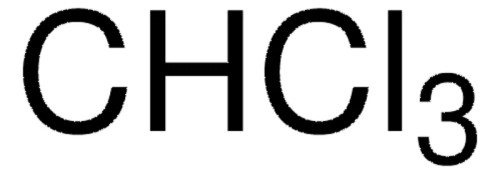
Chloroform, a halogenated hydrocarbon, is widely used as a solvent and extractant in various manufacturing and laboratory procedures. It can be produced by the chlorination of methane or lower-chlorinated methanes. Additionally, it is employed in the production of dichlorocarbenes, α-trichloromethyl carbinols, and trichlorolithiocarbenoids.
Application
Chloroform can be used as a solvent in the:
- Enzyme-catalyzed ring-opening polymerization of ω-pentadecalactone to prepare polyesters.
- Pd-catalyzed cross-coupling reaction of acid chlorides with arylboronic acids to synthesize diaryl Ketones.
- Enantio- and diastereoselective nitro-Mannich reaction of α-aryl nitromethanes with amido sulfones to synthesize β-nitroamines.
- Diels-Alder reaction to synthesize spiro-fused dihydropyans. The hydrogen bond (CH-O) formed between chloroform and carbonyl oxygen makes the carbonyl group a stronger heterodienophile, resulting in an increased reaction rate.
Molecular Weight: 119.38. Empirical Formula: CHCl
3. grade: ACS reagent. Quality Level: 200. vapor density: 4.1 (vs air). vapor pressure: 160 mmHg ( 20 °C). Assay: ≥. 99.8%. form: liquid. contains: ethanol as stabilizer. impurities: Acetone and aldehyde, passes test, Acid and chloride, passes test, Free chlorine (Cl), passes test, H
2SO
4, passes test. evapn. residue: ≤. 0.001%. color: APHA: ≤. 10. refractive index:
n20/D 1.445 (lit.). bp: 60.5-61.5 . °C (lit.). mp: −. 63 . °C (lit.). density: 1.48 . g/mL . at 25 . °C, 1.492 . g/mL . at 25 . °C (lit.). cation traces: Pb: ≤. 0.05 . ppm. storage temp.: room temp. SMILES string: ClC(Cl)Cl. InChI: 1S/CHCl3/c2-1(3)4/h1H. InChI key: HEDRZPFGACZZDS-UHFFFAOYSA-N. Pictograms: GHS06,GHS08. Signal Word: Danger. Hazard Statements: H302 - H315 - H319 - H331 - H336 - H351 - H361d - H372. Precautionary Statements: P202 - P301 + P312 - P302 + P352 - P304 + P340 + P311 - P305 + P351 + P338 - P308 + P313. Hazard Classifications: Acute Tox. 3 Inhalation - Acute Tox. 4 Oral - Carc. 2 - Eye Irrit. 2 - Repr. 2 - Skin Irrit. 2 - STOT RE 1 Oral - STOT SE 3. Target Organs: Central nervous system. Storage Class Code: 6.1D - Non-combustible, acute toxic Cat.3 / toxic hazardous materials or hazardous materials causing chronic effects. WGK: WGK 3. Flash Point(F): does not flash. Flash Point(C): does not flash.

 akash.verma@cenmed.com
 (732) 447-1115