Application
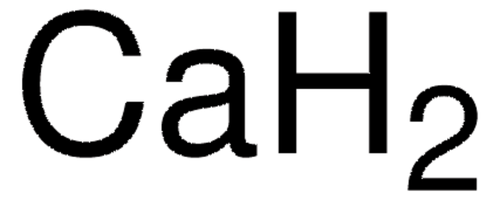
Calcium hydride (CaH2) can be used as a reducing agent to synthesize metallic elements (e.g., Ti, Zr, V, Nb, U, and Th) from metal oxides via the calcium hydride reduction process at higher temperature (600–1000°C). Metallic calcium produced by thermal decomposition is the actual reducing agent in this process. CaH2 is also used to reduce various metal hydrides to metals.
Analysis Note
Assay (by gasvolumetry): ≥ 95.0 %
Particle size: 0 -20 mm
Molecular Weight: 42.09. Empirical Formula: H
2Ca. Quality Level: 200. form: solid. autoignition temp.: >. 300 . °C. reaction suitability: reagent type: reductant. mp: 816 . °C. density: 1.9 . g/cm
3 . at 20 . °C. storage temp.: 2-30°C. InChI: 1S/Ca. InChI key: OYPRJOBELJOOCE-UHFFFAOYSA-N. Pictograms: GHS02,GHS07. Signal Word: Danger. Hazard Statements: H260 - H315 - H319. Precautionary Statements: P223 - P231 + P232 - P264 - P280 - P302 + P352 - P305 + P351 + P338. Hazard Classifications: Eye Irrit. 2 - Skin Irrit. 2 - Water-react 1. Storage Class Code: 4.3 - Hazardous materials, which set free flammable gases upon contact with water. WGK: WGK 1. Flash Point(F): Not applicable. Flash Point(C): Not applicable.

 akash.verma@cenmed.com
 (732) 447-1115