Application
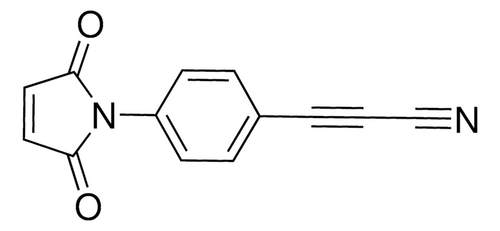
APN-COCl is a bifunctional reagent appropriate for the introduction of APN function.
Other Notes
The coupling between an amine and APN-COCl should be performed in dry organic solvents (e.g. THF) in the presence of a base (e.g. TEA). The resulting conjugate can be readily coupled with thiol-containing biomolecules using the following protocol:
- Dissolve the protein in the appropriate buffer with pH 6.5-9.0 (e.g. PBS) at 1-10 mg/mL concentration.
- Apply the appropriate amount of the stock solution of the APN-labeled molecule (1-5 molar eq. per free cysteine residue).
- Incubate at room temperature for 2 hours.
If necessary, purify the protein conjugate using size exclusion chromatography or ultrafiltration.Molecular Weight: 189.60. Empirical Formula: C
10H
4ClNO. form: powder. Quality Level: 100. reaction suitability: reagent type: cross-linking reagent. storage temp.: 2-8°C. SMILES string: N#CC#CC1: CC: C(C(Cl): O)C: C1. InChI: 1S/C10H4ClNO/c11-10(13)9-5-3-8(4-6-9)2-1-7-12/h3-6H. InChI key: OWNJCJKKKZXTIX-UHFFFAOYSA-N. Pictograms: GHS05,GHS07. Signal Word: Danger. Hazard Statements: H302 - H314. Precautionary Statements: P260 - P270 - P280 - P301 + P312 - P303 + P361 + P353 - P305 + P351 + P338. Hazard Classifications: Acute Tox. 4 Oral - Eye Dam. 1 - Skin Corr. 1B. Storage Class Code: 8A - Combustible, corrosive hazardous materials. WGK: WGK 3. Flash Point(F): Not applicable. Flash Point(C): Not applicable.

 akash.verma@cenmed.com
 (732) 447-1115