 akash.verma@cenmed.com
 (732) 447-1115

Application
Anthraquinone (AQ) can be used:
- In the synthesis of water-soluble anthraquinone derivatives such as 9,10-anthraquinone-2,6-disulfonic acid, disodium salt (AQ-2,6) and 9,10-anthraquinone-2-sulfonic acid, monosodium salt (AQ-2). These AQ derivatives are useful as redox catalysts for aeration in Becher process.
- As an indicator to determine the acid strength of poly(4-vinylpyridinium) hydrogen sulfate (P(4-VPH)HSO4) catalyst.
- As a pulping catalyst.
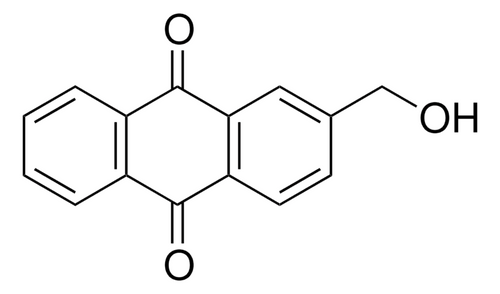
Molecular Weight: 208.21. Empirical Formula: C14H8O2. vapor density: 7.16 (vs air). Quality Level: 200. vapor pressure: 1 mmHg ( 190 °C). Assay: 97%. form: powder. bp: 379-381 . °C (lit.). mp: 284-286 . °C (lit.). SMILES string: O: C1c2ccccc2C(: O)c3ccccc13. InChI: 1S/C14H8O2/c15-13-9-5-1-2-6-10(9)14(16)12-8-4-3-7-11(12)13/h1-8H. InChI key: RZVHIXYEVGDQDX-UHFFFAOYSA-N. Pictograms: GHS07,GHS08. Signal Word: Danger. Hazard Statements: H317 - H350. Precautionary Statements: P202 - P261 - P272 - P280 - P302 + P352 - P308 + P313. Hazard Classifications: Carc. 1B - Skin Sens. 1. Storage Class Code: 6.1C - Combustible, acute toxic Cat.3 / toxic compounds or compounds which causing chronic effects. WGK: WGK 1. Flash Point(F): 482.0 °F - closed cup. Flash Point(C): 250 °C - closed cup. Personal Protective Equipment: dust mask type N95 (US), Eyeshields, Faceshields, Gloves.
- UPC:
- 41113002
- Condition:
- New
- HazmatClass:
- No
- MPN:
- A90004-250G
- CAS:
- 84-65-1