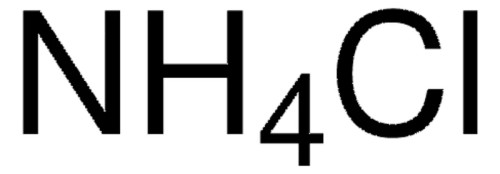
General description
Crystals of ammonium chloride (NH4Cl) belong to the cubic crystal system. It can be synthesized by reacting HCl with aqueous ammonia solutions. NH4Cl is formed as a by-product during soda manufactured by Solvay process.
Application
Ammonium chloride (NH4Cl) has been used as one of the components of red blood cell (RBC) lysis buffer for use in various studies. It may be used as a catalyst in the preparation 3,4-dihydropyrimidin-2-(1H)-ones.
Inorganic ammonium ions (NH4+) effectively catalyze the aldol condensation of carbonyl compounds. It serves as a source of nitrogen during the preparation of trimethylamine hydrochloride (TMA·HCl).
Molecular Weight: 53.49. Empirical Formula: H
4ClN. linearFormula: NH
4Cl. grade: ACS reagent. Quality Level: 200. vapor density: 1.9 (vs air). vapor pressure: 1 mmHg ( 160.4 °C). Assay: ≥. 99.5%. form: powder, crystals or chunks. impurities: ≤. 0.005% insolubles. ign. residue: ≤. 0.01%. pH: 4.5-5.5 (25 . °C, 5%). mp: 340 . °C (subl.) (lit.). anion traces: phosphate (PO
43-): ≤. 2 . ppm, sulfate (SO
42-): ≤. 0.002%. cation traces: Ca: ≤. 0.001%, Fe: ≤. 2 . ppm, Mg: ≤. 5 . ppm, heavy metals: ≤. 5 . ppm (by ICP). SMILES string: N.Cl. InChI: 1S/ClH.H3N/h1H. 1H3. InChI key: NLXLAEXVIDQMFP-UHFFFAOYSA-N. Pictograms: GHS07. Signal Word: Warning. Hazard Statements: H302 - H319. Precautionary Statements: P264 - P270 - P280 - P301 + P312 - P305 + P351 + P338 - P337 + P313. Hazard Classifications: Acute Tox. 4 Oral - Eye Irrit. 2. Storage Class Code: 13 - Non Combustible Solids. WGK: WGK 1. Flash Point(F): Not applicable. Flash Point(C): Not applicable.

 akash.verma@cenmed.com
 (732) 447-1115