 akash.verma@cenmed.com
 (732) 447-1115

General description
Actinomycin D is a polypeptide antibiotic first described by Waksman. It is bacteriostatic in nature, especially towards gram negative bacteria, and also has anti-tumor activity.
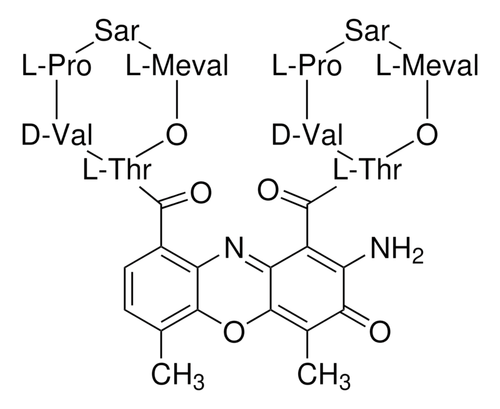
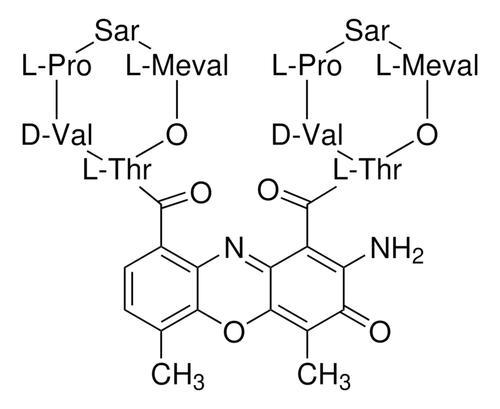
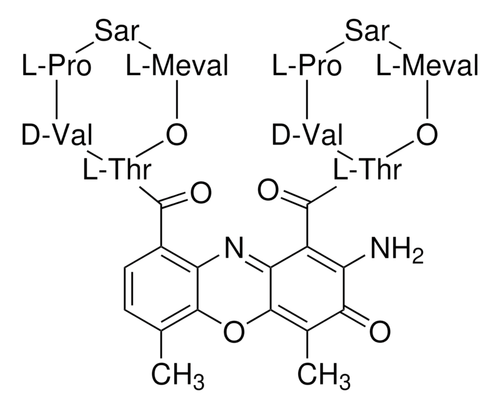
Chemical structure: peptide
Application
Actinomycin D has a wide-ranging applications ranging from a selection agent in cell culture, use in studies of suppressing HIV-replication and programmed cell death of PC12 cells.
Biochem/physiol Actions
Actinomycin D inhibits the proliferation of cells by forming a stable complex with double-stranded DNA, inhibiting DNA-primed RNA synthesis and causing single-stranded breaks in DNA. It has been shown to be an inhibitor of the minus-strand transfer step in reverse transcriptase.
Caution
This product is hygroscopic and light-sensitive. If stored protected from light and moisture at 2-8°C, it remains unchanged, by HPLC testing, for at least 15 months. Unused dilute solutions of Actinomycin D are extremely sensitive to light and tend to adsorb to plastic and glass and should be discarded. However, frozen aliquots of concentrated stock solution are stable for at least a month.
Preparation Note
Actinomycin D is sold as red, shiny crystals and is soluble in acetonitrilie or acetone at 10 mg/mL and in DMSO at a minimum of 1 mg/mL. Some references also show slight solubility in water of 0.5 mg/mL.
Other Notes
Keep container tightly closed in a dry and well-ventilated place. Keep in a dry place.
Molecular Weight: 1255.42. Empirical Formula: C62H86N12O16. biological source: Streptomyces sp.. Quality Level: 300. Assay: ~98% (HPLC). form: powder. optical activity: [α. ]/D alpha: 28/D (Rotation: -315 degrees (c: 0.25% in methanol)). color: red to orange, red, powder. mp: 251-253. solubility: DMSO: 1 . mg/mL, ethanol: soluble. antibiotic activity spectrum: neoplastics. Mode of action: DNA synthesis | interferes. storage temp.: 2-8°C. SMILES string: CC(C)[C@H]1NC(: O)[C@@H](NC(: O)c2ccc(C)c3OC4: C(C)C(: O)C(N): C(C(: O)N[C@H]5[C@@H](C)OC(: O)[C@H](C(C)C)N(C)C(: O)CN(C)C(: O)[C@@H]6CCCN6C(: O)[C@H](NC5: O)C(C)C)C4: Nc23)[C@@H](C)OC(: O)[C@H](C(C)C)N(C)C(: O)CN(C)C(: O)[C@@H]7CCCN7C1: O. InChI: 1S/C62H86N12O16/c1-27(2)42-59(84)73-23-17-19-36(73)57(82)69(13)25-38(75)71(15)48(29(5)6)61(86)88-33(11)44(55(80)65-42)67-53(78)35-22-21-31(9)51-46(35)64-47-40(41(63)50(77)32(10)52(47)90-51)54(79)68-45-34(12)89-62(87)49(30(7)8)72(16)39(76)26-70(14)58(83)37-20-18-24-74(37)60(85)43(28(3)4)66-56(45)81/h21-22,27-30,33-34,36-37,42-45,48-49H,17-20,23-26,63H2,1-16H3,(H,65,80)(H,66,81)(H,67,78)(H,68,79)/t33-,34-,36+,37+,42-,43-,44+,45+,48+,49+/m1/s1. InChI key: RJURFGZVJUQBHK-IIXSONLDSA-N. Pictograms: GHS06,GHS08. Signal Word: Danger. Hazard Statements: H300 - H350 - H360FD. Precautionary Statements: P201 - P202 - P264 - P270 - P280 - P301 + P310. Hazard Classifications: Acute Tox. 2 Oral - Carc. 1B - Repr. 1B. Storage Class Code: 6.1A - Combustible, acute toxic Cat. 1 and 2 / very toxic hazardous materials. WGK: WGK 3. Flash Point(F): Not applicable. Flash Point(C): Not applicable. Personal Protective Equipment: Eyeshields, Faceshields, Gloves, type P3 (EN 143) respirator cartridges.- UPC:
- 51111704
- Condition:
- New
- HazmatClass:
- Yes
- MPN:
- A1410-10MG
- CAS:
- 50-76-0