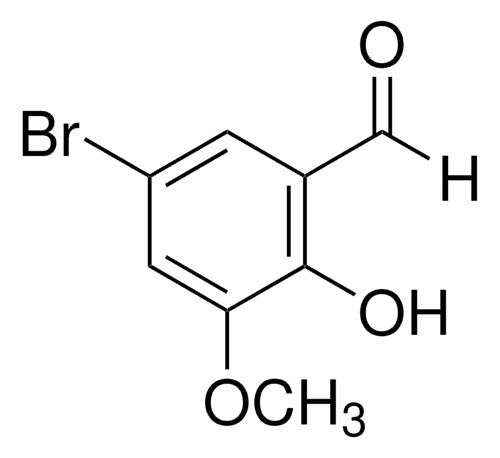
General description
2-Bromo-3-hydroxy-4-methoxybenzaldehyde, also known as 2-bromo-isovanillin, can be synthesized by the bromination of 3-hydroxy-4-methoxybenzaldehyde.
Application
2-Bromo-3-hydroxy-4-methoxybenzaldehyde (2-Bromo-isovanillin) may be used in the preparation of:
- 2-hydroxy-3-methoxybenzaldehyde semicarbazone (HMBS)
- 2-cyclopentyl-7-methoxy-1-benzofuran-4-carbaldehyde
- 3-(benzyloxy)-2-bromo-4-methoxybenzaldehyde
It may also be used as a starting material in the total synthesis of the following natural products:
- pareitropone
- denbinobin
- (±)-codeine
Molecular Weight: 231.04. Empirical Formula: C
8H
7BrO
3. linearFormula: BrC
6H
2(OH)(OCH
3)CHO. Quality Level: 100. Assay: 97%. mp: 202-207 . °C (lit.). SMILES string: COc1ccc(C: O)c(Br)c1O. InChI: 1S/C8H7BrO3/c1-12-6-3-2-5(4-10)7(9)8(6)11/h2-4,11H,1H3. InChI key: QPDFBPIHEDAUKK-UHFFFAOYSA-N. Pictograms: GHS07. Signal Word: Warning. Hazard Statements: H315 - H319 - H335. Precautionary Statements: P261 - P264 - P271 - P280 - P302 + P352 - P305 + P351 + P338. Hazard Classifications: Eye Irrit. 2 - Skin Irrit. 2 - STOT SE 3. Target Organs: Respiratory system. Storage Class Code: 11 - Combustible Solids. WGK: WGK 3. Flash Point(F): Not applicable. Flash Point(C): Not applicable. Personal Protective Equipment: dust mask type N95 (US), Eyeshields, Gloves.

 akash.verma@cenmed.com
 (732) 447-1115