akash.verma@cenmed.com
 (732) 447-1115
-
 808053Features Fiber length (95 %) 2&ndash20 &mum, average degree of polymerization 400&ndash500 specific surface acc. to Blaine 15000 cm 2 /g &le 20 ppm Fe, 6 ppm Cu, 7 ppm P dichloromethane extract &le 0.
 -
809213Features Silica 60, specific surface (BET) ~ 500 m 2 /g, mean pore size 60 Å, specific pore volume 0.75 mL/g, particle size 5&ndash17 µm Outstanding dyeability and abrasion resistance due to an optimized binder system Good wettability
-
811058Features Reversed phase nano silica impregnated with Cu(II) ions and a chiral selector (a proline derivative, DP 31 43 726 and EP 0 143 147) Separation based on ligand exchange, i. e.
-
809028.1Silica 60, specific surface (BET) ~ 500 m 2 /g, mean pore size 60 Å, specific pore volume 0.75 mL/g, particle size 5&ndash17 µm standard grade Thickness of layer for analytical plates 0.
-
809012Silica 60, specific surface (BET) ~ 500 m 2 /g, mean pore size 60 Å, specific pore volume 0.75 mL/g, particle size 5&ndash17 µm standard grade Thickness of layer for analytical plates 0.
-
 6980Helps evaluate washability and abrasion resistance Conforms to ASTM D 2486 The tester reciprocates an abrasive force linearly over the sample. Reciprocating linear motion at 37.
 -
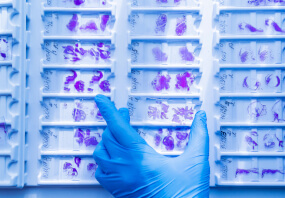
 1.05728.0001These plates are used to analyze polar substances. An organic sorbent, cellulose is perfect for separating hydrophilic substances by partition chromatography.
 -
 1.05718.0001Cellulose plates are used to analyze polar substances. An organic sorbent, cellulose is perfect for separating hydrophilic substances by partition chromatography.
 -
 GE80-1106-94GE GLASS PLATE, SPACER, 125 X 240 X 0.5&
 -
-
-